
Happy Fall! Let’s go over what we’ve been up to over the past couple of months and talk about what we’ll be focusing on next – can you believe the year is just about over?
Demo Updates

In case you missed it – we released the graphical overhaul demo (and a patch) in September and October respectively! We’ve redone the water, redone the overworld, added passive animals, more audio and improved the performance all over the place! We’ve also got a slew of bug fixes, improvements, engine upgrades and other changes. See the release notes for all the details!
Jenkins & Automated Testing
In our last couple of updates we talked about taking a step back and handling some technical improvements. After the demo update came out that is exactly what we have done so let’s chat a little bit about it overall.
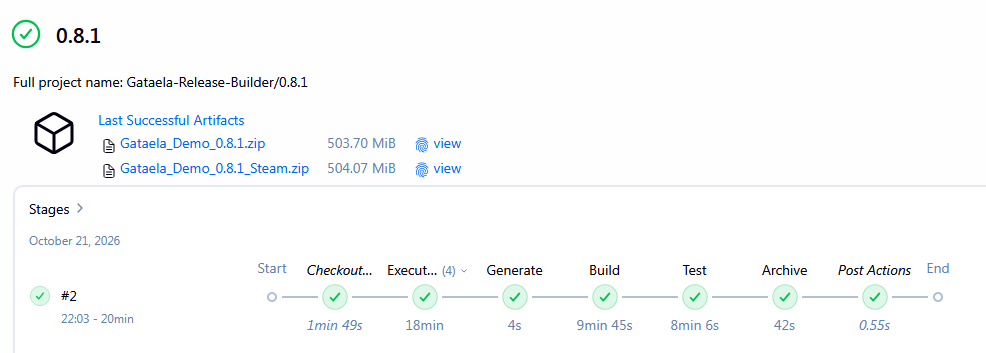
Jenkins is “an open source automation server which enabled developers to reliably build, test and deploy their software”. Essentially it’s a tool that enables developers to automate a lot of tedious processes and ensure that every time they make a change they don’t break anything. It is highly configurable so if we wanted to run tests on every change, make builds all the time, run specific tests on a schedule, etc. we could. The two main ways we are using it right now is to create releases and check that each change added to the game does not break anything.
No one likes games that constantly break on every update. So the biggest hurdle to getting the game done and released is how to verify the quality of the game. We do not have any dedicated testers so we end up in a situation where we could be developing or we could be testing, but not both. That also means that if things break it takes a while to get releases out the door to everyone which also isn’t very enjoyable if it’s an immediate game breaking bug.
Our last other issue was about how long it would take to get a build out. Not only did we have to test all of the builds but we also had to package the builds up for each storefront, make sure the full game spoilers were stripped from the demo, and generate and write the release too. This usually took easily 5-10 hours to put everything together. We had a whole word document to make sure it was done right.
Now? It takes about 30 minutes.
We setup the version information, click a button, and while it’s building we generate and write the release. Once it’s done we go to each storefront, make sure each version is correct and hit that release button.
The pipeline now handles stripping the full game information from the demo, building and configuring for each platform, uploading to (some) platforms, and automatically testing it.
This is how we managed to quickly release 0.8.1 during a weekday evening and still have time to do other things.
That being said – as impressive as this all is we will still have some manual testing but with all hope that it will become very very easy. There’s a lot of different ways to test a game: video recordings, unit tests, end to end tests, screenshot tests, etc. but one thing that cannot be tested is “game feel”.
For example: how do you know that the animation feels better taking 0.1s than 0.3s? A person will be able to tell you that. But once you’ve figured out that 0.1s feels better, you can make it test that the animation always takes 0.1s.
The places where the testing will help the most will be in making sure that the decisions that the developers have made do not change, and if they do, it was intentional. Also to ensure that “funny” bugs do not happen.
For example: Can the player get softlocked transitioning between any levels in the game? If we have 100 levels, and each one goes to at least one other one, that’s a whole lotta transitions to check. Is it worth our time to check every transition in the game for a regression? No – it can easily take a brain numbing amount hours to complete this. Automated testing? It’s done in less than a second.
With that said here’s a couple automated tests we added in the last month:
- When the game starts the first cutscene is triggered and starts
- Make sure that every cutscene on a specific level is configured correctly
- Make sure that every level in the game loads under 30MS
- Make sure that all transitions in the game of a certain type do not softlock
There’s a lot more to add but this is a good starting point to show that it does work and it does lift a very tangible burden from verifying the game.
What’s Next?
With the current technical improvements out of the way we’ll be moving back into development. We parked the Debate work in order to focus on both the improvements and demo update so we’ll be getting back to that. In addition we’ve begun working on various polish and improvement tasks. Some things that will be coming up will be:
- Swapping the dialogue boxes to use Scribble instead of the custom implementation – this will allow for more dynamic cutscenes, debates and interactions with NPCs
- Adding checkpoint flags to both battle systems – this will allow players to resume from a checkpoint instead of failing the whole battle. Most important to the debate battles which will take a while.
- Adding walking SFX to NPCs in cutscenes
- Implementing cutscene & skit skipping
- Adding some polish to UI animations
- Various bug fixes & polish changes
And with that we’ll see you all in the new year!
 0.8.1 Release Notes
